Preparing The Parchment :
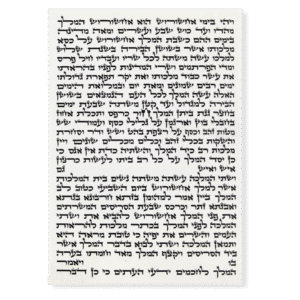
After the scribe has completed his writing, the parchment is rolled (not folded or creased) from left to right, so that the first word to appear when the Mezuzah is opened is “Sh-ma” (see Figure A). The Mezuzah is then wrapped in wax paper and placed into a protective cover.
CLICK FOR IMAGE
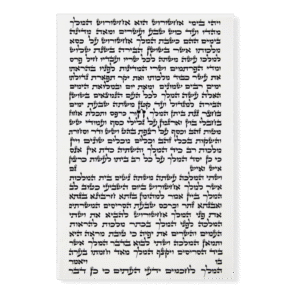
The letters on the outside of the rolled Mezuzah parchment must be upright and facing the doorway (see Figure B). The Mezuzah is now ready to be affixed to the doorpost.
CLICK FOR IMAGE
Places That Require a Mezuzah:
1. All permanent dwellings need a Mezuzah.
2. The requirement extends to every interior room of a house as well, except for undignified areas such as bathrooms.
3. A storage or utility room that is in regular use, such as a garage or boiler room should have a Mezuzah.
4. A ‘Succah’ – used only for the holiday – does not need a Mezuzah but a trailer or camper – if used as a dwelling – must have a Mezuzah.
5. If a room has two entrances, both require a Mezuzah.
6. All hallways leading to a room that requires a Mezuzah, require a Mezuzah.
Where to Put the Mezuzah:
1. The Mezuzah should be affixed on the doorpost, on the right, determined by way of entry into the room.
2. The Mezuzah should be placed within the upper third of the doorpost, (preferably the bottom of the upper third,) but not within the uppermost four inches.
3. It should be attached at an angle with the top slanting into the room. Sphardim follow the Shulchan Aruch who says that the Mezuzah should be affixed in a vertical upright position.
CLICK FOR IMAGE
When to Put Up the Mezuzah:
1. If the home is owned by the dweller, the Mezuzot must be put up on the first day of moving in.
2. When moving into a rented home or apartment, you have up to 30 days to install the Mezuzot, though the sooner done, the better.
3. A Mezuzah can be installed during day or night.
The Blessing:
1. Just before attaching the Mezuzah, one should say the following blessing: “Baruch Ata Ado-nai Elo-heinu Melech Haolam, Asher Kidshanu B’mitzvotav V’tzivanu Lik’boa Mezuzah.” (“Blessed art Thou, Lord our God, King of Universe. Who has sanctified us with His commandments and commanded us to affix the Mezuzah.”)
2. The Mezuzah, in its case, is then nailed, screwed or glued in place on the doorpost.
3. When putting up more than one Mezuzah, only one blessing is recited for all of them and one should not talk of, or get involved with other matters until all of the Mezuzot are affixed.
Note: The blessing should be recited on an opening which has a door and leads to a room larger than 6×6 feet.
4. Any household member of Bar or Bat Mitzvah age and above can recite the blessing and put up the Mezuzah.
5. Places that require a Mezuzah and a blessing include an entrance to a house, doorways more than 40 inches high and all rooms of the house.
6. The following need a Mezuzah but no blessing is recited:
• A room is more than 36 sq. feet, and one dimension of the room is less than 6 feet (example: a 4×10 room) then the Mezuzah is affixed without a blessing.
• Retail/wholesale stores, business offices, storage rooms, walk-in closets and rooms with no doors require Mezuzot but without the blessing.
7. Bathrooms, saunas, doorways less than 36 inches high, rooms whose area is less than 36 sq. feet and temporary dwellings do not require a Mezuzah.
Please note: Aside from the more obvious room settings, there are a variety of details which are not so clear-cut, and depending on a number of factors, Mezuzot may or may not be necessary. These factors are complicated and are based on :
A. The definition of the usage of the room (dwelling, storage, synagogue, a store, gazebo, hallway, etc.)
B. The type of dwelling (temporary housing, inn, caravan, hospital, etc.)
C. The definition of ownership ( owner, renter, guest, partner with a gentile, etc.).
D. The definition of a “house” (square footage, height, a roof, etc.)
E. The construction of the opening (attic doors, one doorpost, rounded top, sliding doors, end of a wall, etc.)
F. The function of the opening (for decoration, supporting beams, etc.)
For clarity on what to do in such circumstances, or any other situation where a question may arise, please consult with a competent Rabbinic authority.






Reviews
There are no reviews yet.